In the Indian tradition, Reality has been experientially perceived as a triune of Existence-Consciousness-Bliss or Sachchidānanda. Bliss or Ānanda is the value aspect of Reality but in its pure poise it is inaccessible to the ordinary human being. In fact, any premature attempt to access this aspect of Reality might be counter-productive unless one has the experience of identifying with the inmost essence of one’s consciousness — the ego-surpassing fourth-dimensional principle named by Sri Aurobindo as the psychic being.
The ordinary human being reacts to the stimuli of life with the triple response of pain, pleasure and indifference. This is not only a superficial response to the shocks of life but also man’s initial response in creation. It is only through developing a technology of consciousness that one can go behind this initial and superficial response. We shall first attempt to understand this external response in terms familiar to the ordinary mentality. Why does Sri Aurobindo select ‘Pain-Pleasure-Indifference’ as the triple vibration (1) to which we are subjected on exposure to the shocks of existence? Sri Aurobindo does not select these responses in a casual manner. In fact, he selects them specifically because they represent three distinct responses that arise at the three levels of manifestation which appear successively in the evolution of consciousness.
This is the level that manifests when the physical consciousness is permeated by the Life-Energy (the vital) to form the basis of our bodily life. It is only here that pain makes its first appearance. Sri Aurobindo explains that pain, “… does not come into being in the purely physical world so long as life does not enter into it; for till then mechanical methods are sufficient. Its office begins when life with its frailty and imperfect possession of Matter enters on the scene… (2).”
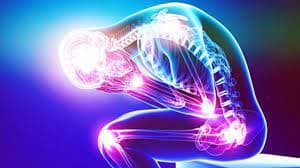
Pain is not only a physical suffering; it is accompanied by emotional and/or mental distress. Psycho-physiology explains how pain-impulses enter the spinal cord and are transmitted to the brainstem and thalamus. It also explains how the perception of pain varies enormously among individuals, being conditioned by past experiences, cultural attitudes, gender stereotypes, genetic make-ups and Hathayogic practices. It is no wonder that the inadequate management of pain is one of the leading causes of active euthanasia – a phenomenon that is in direct conflict with the Ānanda aspect of Reality!

In Sri Aurobindo’s classification of the planes and ranges of consciousness, it is the “vital physical” (also known as the nervous being), which is enmeshed in “the reactions, desires, needs, sensations of the body (3)”. The vital-physical is the hallmark of our bodily-life and is that aspect of consciousness that mediates our pain.
However, the body is accustomed to fixed habits. Its unique characteristic is its resistance to change. This is quite understandable. If we were made up of only subtle things like emotions and ideas, we would be an amorphous mass of confusion! Nature had to make a formation that is durable, that can withstand disruptive forces, that does not fluctuate with the rapidity and fluidity of emotions and ideas. Naturally, such a formation as our physical body must have a certain fixedness that our emotions and ideas lack. Unfortunately, this fixedness and rigidity can lead to “a false impression of absoluteness (4).” This is how certain bodily characteristics (notably pain) can become a habit of our nature.
Things become more complicated when our chronic habits sink into the subconscious (the Freudian Unconscious) to have the capacity to bounce back at other times in life, leading to relapses and exacerbation of old habits!
Fortunately, this is not the end of the world. There are higher planes of consciousness that manifest once the bodily life is stabilised. These higher planes like the plane of mind are capable of more flexibility and variation and can break the fixity of bodily habits!

Level 2 is the level of our emotional repertoire (designated by Sri Aurobindo as vital) that manifests once bodily life is stabilised. Of course, the bodily life necessitated a permeation of Matter by the life-force of the vital. But the full efflorescence of the vital that we see in human beings (in contrast to forms of animal life below the human being in evolution) is a unique manifestation. This is the plane of consciousness, which contains all our dynamism, our passions, our desires, lusts, longings, our will, our zeal to build, construct as well as to destroy.
This is the level from which our sensation of pleasure arises. Naturally, there is a gradation of pleasures. There is the pleasure of our sensual satisfaction when the reactions of our bodily senses (in Level 1) are invested with emotional values (from Level 2). There are higher pleasures which are characteristic of Level 2: the joy of success; the pleasure of our fortunes; the pleasure of satisfaction of our greed, desires, ambitions; the pleasures we get from our emotional transactions with our fellow-beings.
The problem is that all such pleasures are short-lived. Moreover, such pleasure can immediately change into the polar opposite, bringing in sorrow, hatred, revolt or revenge. At any cost, it does not reflect the Ānanda aspect of Sachchidānanda. Rather, it is best epitomised in this passage in Savitri, which shows that at the end it leads to nowhere:
“Pain with its lash, joy with its silver bribe
Guard the wheel’s circling immobility (5).”
That is why, Sri Aurobindo explained that what we ordinarily perceive as joy does not necessarily reflect the Divine Bliss but is a vital feeling that, “Joy is a vital feeling, like its opposite, sorrow (6).”

Level 3 is the level of the cognitive mind, which manifests when our vital (Level 2) is optimally stabilised on the foundation of our bodily-life (Level 1). This is the level of our ideas, thoughts, speculations, conceptions and abstractions.
Unfortunately, this is also the level from which doubts, scepticism, faithlessness and pessimism arise. This can result in a mental indifference as a response to the shocks of life. This indifference should not be confused with the detachment and equanimity of the Yogis, which is a different thing.
The superficial sensation of indifference is quite evident when we are demoralised, demotivated, depressed; become subject to boredom, alienation and meaninglessness in life. It is characteristic of low self-esteem — an attitude that we cannot disregard if we consider the WHO estimate that by the end of the first quarter of the twenty-first century, depression per se is expected to emerge as the second largest chronic disease in the world!
Ironically, the reaction of indifference is even demonstrated in the shift of the universal substance of abuse from hallucinogens like LSD to opioids like heroin. LSD gave romantic feelings — perceptions changed and became impregnated with colours and meanings. Heroin, on the other hand, does not give any colourful experience, but a zombie-like feeling of indifference so that the addict can be cut off from the banality of the world!

Can ‘pain-pleasure-indifference’ be surpassed?
Of course, there are certain points to be considered:
1. The triple vibration of ‘pain-pleasure-indifference’ is just an obligation of habit. Habits can also be changed or substituted. This is what Behaviour therapy and Cognitive-Behaviour therapy attempt in counselling sessions.
2. By training, we can return the opposite response: “… pleasure where we used to have pain, pain where we used to have pleasure (7)”. That is how during altered states of consciousness, one can jump on a bed of thorns, or walk through fire, or pierce oneself with a weapon without having pain or bleeding.
It is interesting to note that these neuro-vascular changes during altered states of consciousness are speculated to be mediated through opium-like chemicals in our body, called endogenous opioids that are the body’s natural analgesics. It is also now believed that these endogenous opioids are:
a. Responsible for the placebo reaction —the psychological factor that is the real therapeutic motivator in any treatment.
b. The analgesia produced by acupuncture and allied therapies.
In other words, the mind itself can relieve pain in the body by influencing the production of endogenous opioids.