Background and uses
Turmeric or Curcuma longa, while a spice native to south Asia, appears to have migrated to the Far East, the Middle-East and the West via the silk route, as the spice trade thrived, going back about 5000 years. Turmeric is a pungent spice that forms the basis for many curry powders. It is also used as a natural food colourant. Traditionally, turmeric has been used to heal bruises, sprains, leech bites, inflamed joints, severe chest congestions and common colds.
Turmeric is derived from Curcuma longa, a rhizomatous herbaceous perennial plant belonging to the ginger family,Zingiberaceae. The plant grows an underground tuber, or rhizome much like ginger does. It can take between 8 to 10 months for a new crop of roots to develop and it is not a plant that you can harvest in small pieces through the season.
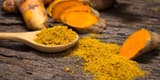
As many as 133 species of Curcuma have been identified worldwide. Most of them have common local names and are used for various medicinal formulations. The turmeric plant needs temperatures of between 20°C and 30°C and a considerable amount of annual rainfall to thrive. Individual plants grow to a height of 1 metre and have long, oblong leaves. Plants are gathered annually for their rhizomes and are reseeded from some of those rhizomes in the following season. The rhizome, from which the turmeric is derived, is tuberous, with a rough and segmented skin. The rhizomes mature beneath the foliage in the ground. They are a yellowish-brown with a dull orange interior. The main rhizome is pointed or tapered at the distal end and measures 2.5-7.0 cm (1-3 inches) in length and 2.5 cm (1 inch) in diameter, with smaller tubers branching off. When the turmeric rhizome is dried, it can be ground to a yellow powder producing a bitter, slightly acrid, yet sweet, taste.

Active constituents
The rhizome or the root part of turmeric is the part used medicinally. More than 100 components have been isolated from turmeric. The main component of the root is a volatile oil, containing turmerone and there are other colouring agents called curcuminoids in turmeric. Curcuminoids consist of curcumin demethoxycurcumin, 5’-methoxycurcumin, and dihydrocurcumin, which are found to be natural antioxidants (1,2). The yellow-pigmented curcuminoids represent 2 -5% of the root, typically 85% as curcumin, 10% as demethoxycurcumin and 5% as disdemethodoxyycurcumin. Curcumin is the most studied component.
Traditional medicines
In Āyurvedic medicine, turmeric is thought to have many medicinal properties, including strengthening the overall energy of the body, relieving gas, dispelling worms, improving digestion, regulating menstruation, dissolving gallstones and relieving arthritis. Many south Asian countries use it as an antiseptic for cuts, burns and bruises, and as an anti-bacterial agent, for respiratory conditions (e.g. asthma, bronchial hyperactivity and allergy), as well as for liver disorders, anorexia, rheumatism, diabetic wounds, runny nose, cough and sinusitis (3). In traditional Chinese medicine, it is used to treat diseases associated with abdominal pain (4).

From ancient times, as prescribed by Āyurveda, turmeric has been used to treat sprains and swelling (5). In both Āyurvedic and traditional Chinese medicine, turmeric is considered a bitter digestive and a carminative. Yunānī (the term for Perso-Arabic traditional medicine as practiced in Mughal India and in the Muslim culture of south Asia and modern day central Asia) practitioners also use turmeric to expel phlegm or kapha, as well as to open blood vessels in order to improve blood circulation. It can be incorporated into foods, including rice and bean dishes, to improve digestion and reduce gas and bloating. It is a cholagogue, stimulating bile production in the liver and encouraging excretion of bile via the gallbladder, which improves the body’s ability to digest fats. Sometimes turmeric, mixed with milk or water, is taken to treat intestinal disorders as well as colds and sore throats.
Uses in modern medicine
Scientific research over the past 50 years, has demonstrated that curcumin (diferuloylmethane), a component of turmeric (Curcuma longa), can modulate cell signalling pathways. Extensive clinical trials have been conducted addressing pharmacokinetics, safety and efficacy against several diseases in humans. Certain promising effects have been observed in patients with various pro-inflammatory diseases such as arthritis, cancer (brain, breast, colon, prostate, colorectal, pancreatic, melanoma) cardiovascular disease, diabetes, Crohn’s disease, ulcerative colitis, irritable bowel syndrome, peptic ulcer, gastric ulcer, gastric inflammation, psoriasis, acute coronary syndrome, atherosclerosis, lupus, nephritis, renal conditions, vitiligo, AIDs, chronic arsenic exposure , alcohol intoxication and hepatic conditions (6).
In dose escalating studies, turmeric has been shown to be safe at as high a dose as 12 g/day for over 3 months. Various formulations have been studied including nanoparticles, liposomal encapsulation, emulsions, capsules, tablets and powder. Some of these delivery mechanisms have managed to improve its bioavailability, metabolism and pharma-cokinetics (7).

Though curcumin has shown efficacy against numerous human ailments, poor bio-availability due to poor absorption, rapid metabolism, and rapid systemic elimination, has been shown to limit its therapeutic efficacy (8). As a result, numerous efforts have been made to improve curcumin’s bioavailability by altering these features. The use of adjuvants that can block the metabolic pathway of curcumin is the most common strategy for increasing the bio-availability of curcumin. The effect of combining piperine (black pepper), a known inhibitor of hepatic and intestinal glucuronidation, was evaluated on the bioavailability of curcumin in healthy human volunteers (9). In humans receiving a dose of 2 g. of curcumin alone, serum levels of curcumin were either undetectable or very low. Concomitant administration of 20 mg of piperine with curcumin, however, produced much higher concentrations within 30 minutes to 1 hour after drug treatment; piperine increased the bioavailability of curcumin by 2,000%. The results imply that adding just one percent of piperine to turmeric could enable better absorption and metabolism.
Most of the curcumin clinical studies have been focused mainly on people with health problems. A recent study, however, evaluated the health-promoting efficacy of lipidated curcumin in healthy middle-aged participants (40-60 years-old). In this study, the participants were given either lipidated curcumin (80 mg/day) or placebo for 4 weeks. Curcumin, but not placebo, produced decrease in plasma levels of triglycerides and beta amyloid (plaque). Furthermore, curcumin administration in these participants increased free radical scavenging capabilities. These results demonstrated the health-promoting effects of lipidated curcumin in healthy middle-aged people (10). Adding ghee or extra virgin coconut oil to turmeric can better its absorption.
Health benefits of turmeric
• Potential benefits from regular use are numerous. They include improved circulation, the prevention of blood clots, and alleviation of menstrual and menopausal complaints.

• It can stimulate the flow of bile and thereby promote the digestion of fats and expedite the liver’s ability to detoxify fat soluble metabolic and environmental toxins, such as pesticides, herbicides, medications, and synthetic hormones given to commercial animals to increase their size and yield of milk and meat.
• Turmeric has hepato-protective activity and can help prevent viral or chemical induced liver damage, as well as enhancing hepatic glutathione, a powerful cell protector and phase 2 liver detoxification enzyme precursor.
• Turmeric is a powerful anti-inflammatory, immune-regulator and mild analgesic used in the amelioration of osteoarthritis, rheumatoid arthritis, and bursitis. It is also effective in the healing of inflammatory conditions of the GI tract such as ulcerative colitis, Crohn’s disease, celiac disease, gastritis and gastric ulcers.
• Turmeric gradually lowers blood pressure, reduces LDL cholesterol levels, oxidative damage to the liver, blood vessels (atherosclerosis) and eyes.

• Curcumin is used in the treatment of viral infections such as HIV, and Epstein Barr.
• Since the discovery of turmeric’s antioxidant phenolic compounds and the protection these compounds provide against free radicals, this spice is now viewed as much more than just an ingredient in curry or a yellow dye. Curcumin extracted from turmeric has been found to down-regulate over 70 pro-cancer cell signalling pathways and oncogenes (11).
Cancer: select clinical findings
Other inflammatory diseases: select clinical findings

Summary of clinical findings
The underlying actions and clinical effects of turmeric are: 1)anti-inflammatory, 2) anti-microbial, 3) anti-oxidant, and 4) wound-healing properties. The clinical trial data suggest that turmeric either alone or in combination with conventional modalities reduces the morbidity or mortality from several disease states. Use of turmeric along with the conventional modalities has indicated better health outcomes after turmeric use, reducing the adverse events profile.
Using turmeric as a medicinal agent may change the course of several chronic diseases such as arthritis, allergic rhinitis, asthma, cancer (breast, pancreatic, prostate, colorectal, lung, multiplemyeloma), cardiovascular disease, diabetes, digestive disorders such as irritable bowel syndrome and gastric ulcer to name a few disease states. While the mechanism of action is not entirely clear as to how turmeric works, clinical trial data for cancer show its influence in inhibiting networks of cancer cell growth for example. Curcumin is a natural polyphenol molecule derived from the Curcuma longa plant which exhibits anticancer, chemo-preventive, chemo- and radio-sensitization properties. Curcumin increases the sensitivity of chemotherapeutic drugs and protects from toxicity of cancer therapy.
Doses of 500-8,000 mg. of turmeric per day have been used in human studies. Standardised extracts are typically used in lower amounts, in the 250-2,000 mg. range (33).
Contra-indications
Having been graded ‘Generally Recognized as Safe’ (GRAS) status in the United States of America by the Food and Drug Administration (FDA), turmeric is well tolerated by most people. Avoid turmeric during pregnancy. Not for use in pregnancy unless otherwise directed by a qualified expert. Therapeutic quantities should not be taken by people with bile duct obstructions or gallstones (34).
No significant toxicity has been reported following short or long-term administration of turmeric extracts at standard doses.
Turmeric, a widely-studied plant, has been used in the traditional cuisine and medicine of Āyurveda, Chinese Medicine and in Persian-Arabic systems, to heal a multitude of inflammatory health conditions. Research demonstrates it to be a powerful spice, with curcumin as its primary active constituent that cools inflammation, protects the liver, gut and vascular system while preventing and slowing disease progression in cancer and other advanced illnesses.