
The way to health and happiness
By P. Ram Manohar - Jul 15, 2018
Āyurveda teaches us that health and happiness are achieved through control in the mind. Only when we have unclouded awareness can we then focus on the essence and everything necessary will come to us.

The cosmic evolution
By Srikantha Arunachalam - Jan 15, 2014
This chapter is taken from a book on Āyurveda, written by a wise physician practising in Sri Lanka. It describes in very concrete detail abstract Vedic concepts of Āyurvedic medicine. It also explores briefly how atomic sub-particles could be understood as per Āyurvedic tenets.

Pañcakarma therapies — a detoxifying and rejuvenating technique
By Gayatri Gandhe - Jul 15, 2019
PañcakarmaPañcakarmavamana, virecana, nasya, vasti and raktamokṣaṇasnehanasvedana

Managing imbalance to prevent and cure disease: the approach of Āyurveda to life, health and longevity
By P. Ram Manohar - Jan 15, 2019
The doṣas are the pillars that support the body and, for this reason, their instability leads to the destruction of the body itself. The doṣas are unstable by nature and prone to imbalance. A continuous reconstruction of the body is necessary to keep the doṣas in balance for our health and longevity. Āyurveda makes us recognise the imbalance underlying disease in both early and advanced stages of affliction, helping us to prevent and manage diseases more effectively.
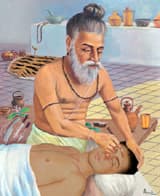
Suśruta saṁhitā su. 3-
By Translated by Sampadananda Mishra - Jan 15, 2016
Ancient physicians of Āyurveda were known to have extraordinary capacities of healing. They could predict the life-span of a person by just looking at him or her. A brief hint on how this was done is given in the Suśruta Saṁhita..